Venomous spider management in North Texas demands an architectural approach rather than broadcast pesticide applications. Brown recluse spiders shelter inside dark, undisturbed indoor zones such as structural attic…
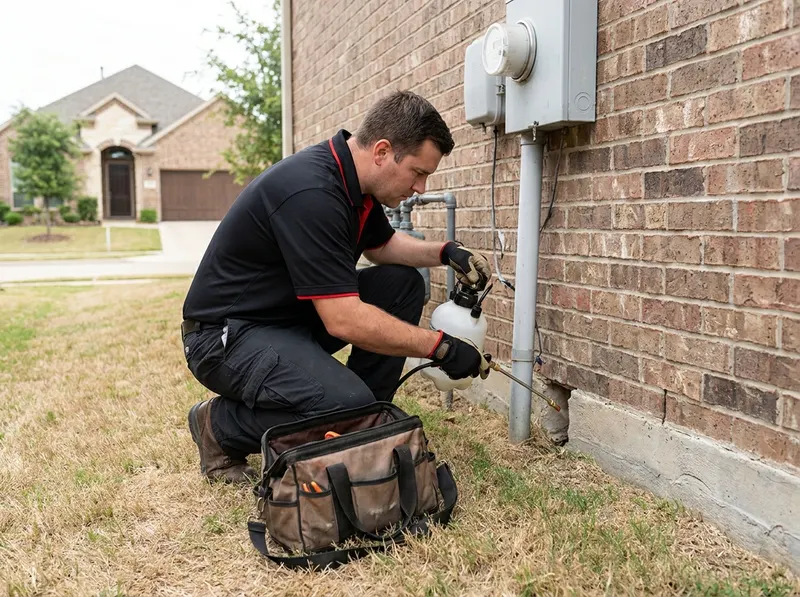
Venomous spider management in North Texas demands an architectural approach rather than broadcast pesticide applications. Brown recluse spiders shelter inside dark, undisturbed indoor zones such as structural attic rafters, cardboard storage, crawlspaces, and behind baseboards, whereas black widows establish tangled cobwebs in exterior utility boxes, meter covers, stone retaining ledges, and slab weep points. CopperNest Pest Defense implements localized residual treatments governed by the EPA pesticide safety standards, using microencapsulated formulations that adhere to the arachnid cuticle without staining drywall or leaving chemical vapors. Technicians conduct visual counts under high-output LED arrays, inspecting crawlspaces and junction boxes before deploying amorphous silica aerosol according to guidelines from the OSHA occupational chemical safety regulations to desiccate spiders sheltering inside deep framing voids.
Master-planned subdivisions across Frisco exhibit specific architectural vectors that support venomous arachnid movement. In communities like Newman Village, Shaddock Creek Estates, and Stonebriar, continuous brick facades incorporate exterior weep holes spaced every 32 inches along the bottom mortar course. These structural gaps permit airflow to avoid moisture accumulation, yet they function as unmonitored ingress channels directly into wall cavities. CopperNest Pest Defense seals these structural apertures using non-corrosive copper mesh insect screening conforming to ASTM International material specifications, stopping re-entry while maintaining mandatory foundation ventilation. Properties bordering the manicured turf corridors near The Trails of Frisco, Panther Creek, and Griffin Parc frequently encounter black widows hunting around exterior irrigation backflow boxes and decorative retaining stones, requiring low-pressure perimeter applications certified under the Texas Department of Agriculture pesticide rules.
Homeowners weighing comprehensive void treatments against standard monthly spray programs must account for fundamental spider biology. Standard surface insecticides repel crawling beetles and ants but fail against hunting arachnids because spiders travel elevated on their tarsi, absorbing negligible toxin from dry barrier films. Effective eradication requires directed micro-dusting into undisturbed insulation, ceiling joists, and electrical voids alongside targeted physical extraction of egg sacs using HEPA-filtered vacuum units compliant with NIOSH filtration standards. For larger floor plans in Starwood, Phillips Creek Ranch, Lawler Park, and Richwoods, integrating mechanical exclusion alongside void dusting requires higher initial labor, yet it ends the recurring indoor cycle. Field work strictly adheres to the Texas A&M AgriLife Extension integrated pest management framework, with product handling matching safety directives from the National Institute of Environmental Health Sciences, toxicological reviews from the Agency for Toxic Substances and Disease Registry, and structural building codes outlined by the International Code Council.
Every job gets a firm, written price after a free on-site visit.
For standards, safe disposal, and service guidance on pest control services in Frisco, TX, useful references include U.S. EPA, ENERGY STAR, U.S. Dept. of Energy, Consumer.gov, U.S. Census Bureau, and Google Maps. General consumer and small-business resources are available from USA.gov, Better Business Bureau, FTC Consumer Advice, U.S. Small Business Administration, and Ready.gov.
Tell us about your brown recluse & black widow targeted control job in Frisco and we'll send a clear, written quote, usually the same day.
 CopperNest Pest Defense